Healthcare Data Conversion and Migration Solutions

Data Conversion and Migration
The groundwork your clinicians will build every decision on
When your organization moves to a new EHR, every record that follows you into that system has to be accurate, complete, and clinically usable from day one. A field that looks correct on the surface but carries the wrong meaning can create real risk for your clinicians, your patients, and your operations, often in ways that do not surface until well after go-live.
MediQuant has completed more than 6,000 migrations across hundreds of legacy platforms. We don't just move your data—we learn it, so what arrives in your new system reflects the clinical reality it came from
6,000+
migrations completed
9 years
average team tenure at MediQuant
700+
legacy systems we've worked with
Why Some Conversions Look Complete and Are Not
Most conversion vendors concentrate on technical delivery: fields mapped, formats matched, data loaded on schedule. That work is necessary, but it addresses only the part of the problem that is visible from the outside.
When data moves without a full understanding of how it was structured and why, the consequences tend to surface later, after go-live, when they are harder and more expensive to fix. Clinical continuity suffers when a patient's history does not translate the way clinicians expect. Administrative workflows break when a field that carried five distinct values in the legacy system gets flattened into two in the new one. These are not edge cases. They are what happens when clinical meaning gets lost in translation, even when every record has technically transferred.
MediQuant works to prevent exactly that. Before any data moves, our team studies how your legacy system captured and structured its information, and why, so the record that lands in your new EHR carries the same clinical weight it did in the system you are retiring.

Partnering with MediQuant for your data conversion allows your organization to:
Move data with no learning curve, backed by a team with an average of nine years of hands-on experience inside the specific legacy platforms most health systems are retiring
Preserve the operational and clinical context behind your legacy data structures, not just the values they contain
Scale internal support up or down, with additional project management, validation, and data loading resources during your most demanding stretch
Confirm technical accuracy and clinical completeness through iterative validation before go-live, not after
Plan pre- and post-go-live data loads so last-minute clinical activity in your legacy system carries over cleanly
Build a single data strategy across conversion and archiving, so every record has a destination and nothing is left behind in a system you are still paying to maintain
Moving to Epic? See our Epic-specific conversion and migration services →
Optimizing Healthcare Data
Every conversion is scoped to your environment, your timeline, and the legacy system you are retiring. The phases below reflect our standard engagement. If your go-live date is already set, the time to start planning is now.
1. Kickoff and Discovery. We review your systems, confirm scope, and establish your project timeline alongside your implementation team.
2. Data Extraction. We work with you to build a unified extraction strategy, including what to request from each legacy vendor, in what format, and how to handle delays or incomplete extracts.
3. Development and Mapping. Your legacy data is transformed into formats your new EHR accepts. Mapping workbooks go to your clinical and operational teams for review before validation begins.
4. Validation. Iterative testing cycles move from technical format checks to chart-by-chart clinical review, confirming completeness and accuracy at every stage.
5. Data Loading. We plan loads before and after go-live so any last-minute activity documented in your legacy system carries over to your new EHR.
What a Successful Conversion Looks Like
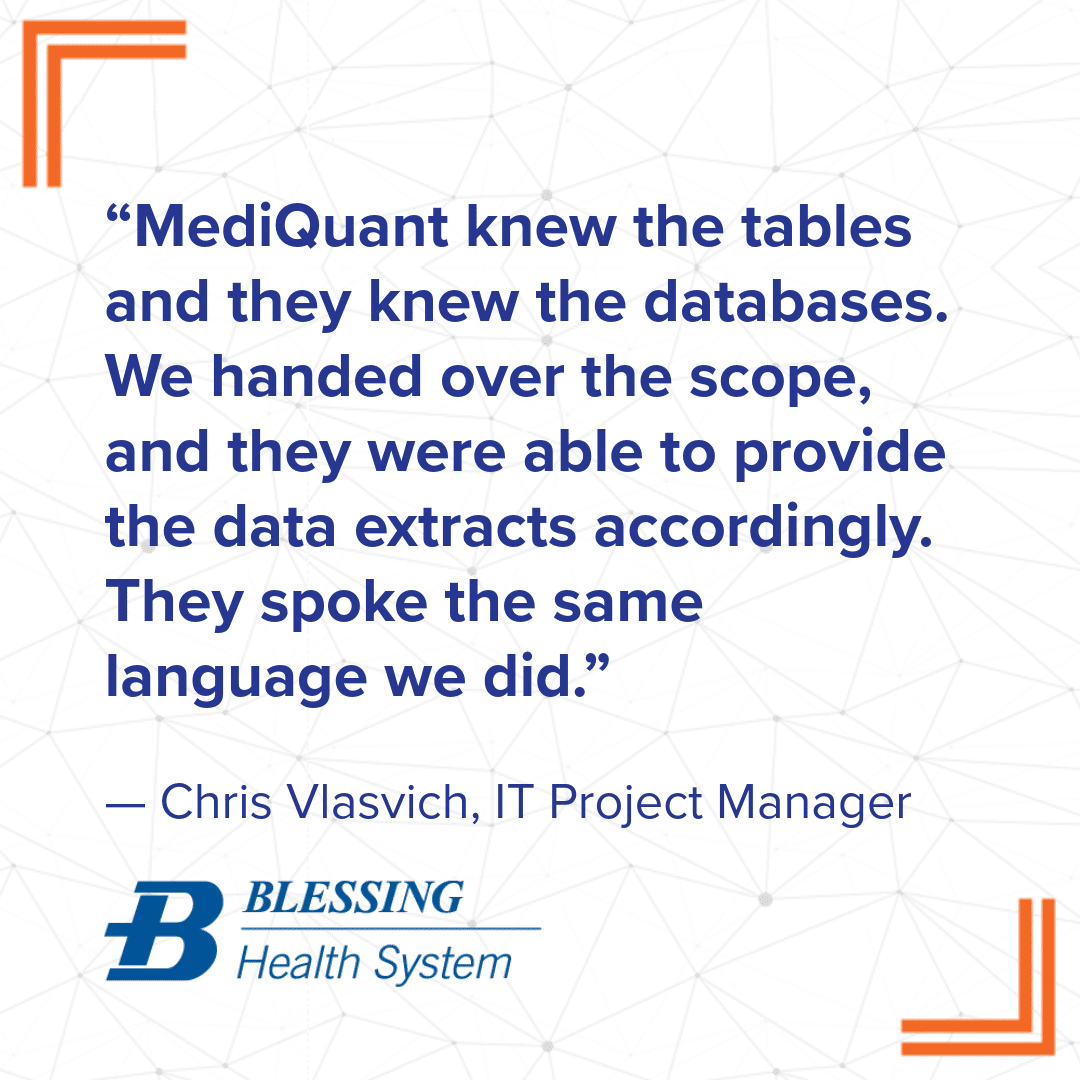
When Blessing Health System moved to Epic, the organization was operating two primary EMRs, hundreds of ancillary systems, and clinical data that did not consistently travel between them. MediQuant worked through Blessing's full application portfolio before a single record moved, identifying where each data set actually originated, which systems could be retired, and what belonged in Epic versus an archive. With that plan in place, Blessing met its March 2026 go-live after a 13-month implementation, and clinicians had three years of converted patient history available on day one.
Evaluating Conversion Partners
Selecting the right conversion and archiving partner shapes how your data performs for years after go-live, not just on the day it happens. This guide walks through the questions worth asking any vendor, from clinician access to legacy revenue cycle data, and the factors your team should weigh before scoping a project.


What Health System Leaders Are Really Saying About Data Lifecycle Management
MediQuant recently partnered with Becker's Healthcare to convene an executive advisory session on...

Healthcare’s Legacy Data Problem Is No Longer an IT Issue. It’s a Patient Safety Issue.
There was a time when legacy applications in healthcare were viewed as an inconvenience; they were...
Blessing Health System Achieves Successful Epic Go-Live Supported by Application Rationalization and a Disciplined Data Conversion
Download Now Blessing Health System Achieves Successful Epic Go-Live Supported by Application...
Ready to scope your conversion?
Contact Us Today
We'd love to hear from you!